Simple Trade
Product & Platform
Cloud-based investment web app
Timeline
2020
Impact
Created a new high-speed entry method that is 70% faster than the standard flow, winning the 2020 SS&C Eze Innovation Challenge.
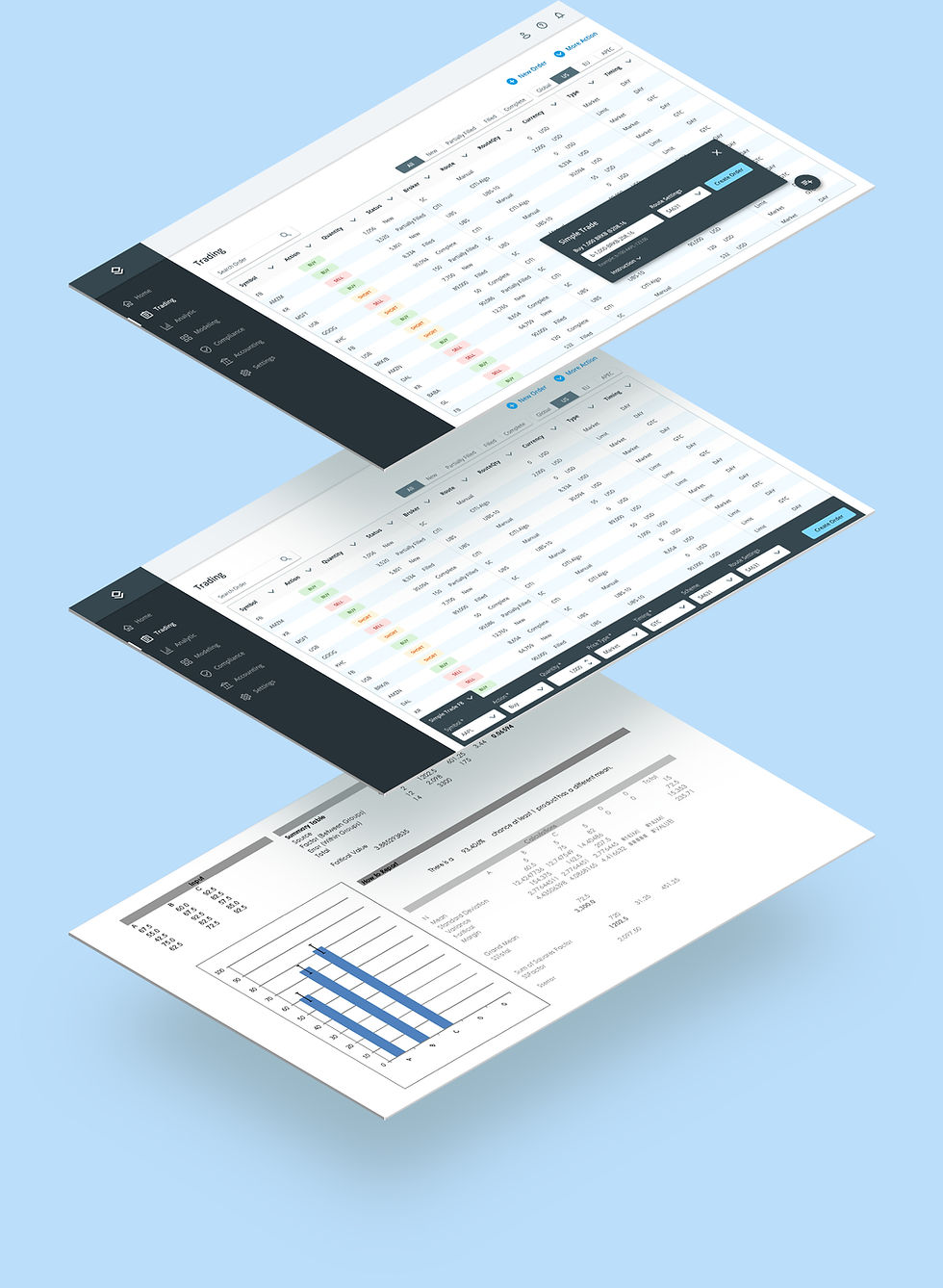
Eclipse is an award-winning platform that supports the full investment lifecycle for small and mid-sized hedge funds, with Trading as its most critical product area. I designed an innovative trade order entry feature that reduced friction in high-frequency workflows and improved trade entry speed by up to 70%. This work led to our team winning the 2020 SS&C Eze Innovation Challenge Championship.
*Confidential information has been omitted or redacted. The designs shown do not represent the final production product.
My Role

Design ownership
Led the project end to end, including research, ideation, wireframing, prototyping, usability testing, and UI design.

User advocacy
Represented user needs by understanding their goals, challenges, and context, and making design decisions grounded in those insights.

Stakeholder collaboration
Partnered closely with product and engineering to align user needs with business and technical goals through effective communication and collaboration.
Project Scope & Plans
I kicked off the project with product and engineering to align on goals, constraints, and success criteria. Simple Trade was defined as a new feature built on the existing order flow to address client demand for faster trade order placement. From a business perspective, the feature aimed to improve trading efficiency, strengthen product competitiveness, and support revenue growth. We aligned on an aggressive timeline, with designs needed within two weeks to support upcoming engineering work.
Feature type
New, additive feature built on an existing trade order flow
Primary user
Hedge fund traders
Usage frequency
Very high (10–30 orders per day)
Design goal
Enable fast, simple trade order creation
Timeline
Two-week design window prior to engineering sprint


User Insights
I revisited the Trader persona established by the UX team and learned that traders are high-frequency, results-driven users who need to act quickly and confidently. They rely on fast, precise workflows, keyboard-driven interactions, and immediate system feedback to execute trades accurately while navigating compliance requirements and complex trading systems.
Client feedback and internal notes shared within the R&D department provided additional insights:
“I need a way to add orders when I’m viewing Analytic data.”
“Many orders were created without routes. I want to add these orders easily.”
“Can we preconfigure routes so I don’t have to fill all those fields when I create an order?”

Competitive Research
I explored quick trade solutions for hedge funds and financial organizations but found no suitable examples. Expanding the search to consumer products, I discovered an inspiring example in Thinkorswim, which features a small, always-accessible trade ticket across most interfaces.
Current Workflow Analysis
To inform the design of the Simple Trade feature, I analyzed the existing trade order workflow across multiple scenarios to understand its strengths and limitations.

Data-Driven Ideation
Analyzing backend tracking data revealed that 80-90% of orders left the "Strategy," "Trader," and "Manager" fields blank, indicating they were unnecessary for a streamlined trade feature. Additionally, 60% of orders were created without route values, while the remaining 40% showed significant similarities in routing. These insights, combined with client requests for preconfigured routes, provided a clear path for simplification.
I began by defining specific metrics to measure "simple and fast" within this context. I then conducted a brainstorming session to identify solutions that would achieve these goals by reducing manual entry and leveraging data-driven defaults.

High-Level Concepts
I sketched multiple ideas and consolidated them into three distinct approaches. After presenting the wireframes to stakeholders, we identified Concept B and Concept C as the most promising directions for further development.
Concept A: Above Blotter
Simple Trade is restricted to the Trading tab as a compact order ticket positioned above the trade blotter. It includes required fields for order details and selections for preconfigured routes.


Concept B: Slide Banner
Designed for cross-platform accessibility, this concept allows the order ticket to be summoned from any screen. The interface is contained within a slide-up banner located at the bottom or via a side menu.


Concept C: “Coding”
This approach allows users to execute orders via shorthand strings, similar to a command-line interface. For example, typing “b-1,000-BRKB-208.16” instantly generates a “Buy 1,000 shares of BRKB at $208.16.” Users access this via a floating, draggable button that remains available across all screens.


Develop Details and Prototypes
Based on stakeholder feedback, I developed high-fidelity wireframes and clickable prototypes for Concepts B and C. These prototypes accounted for diverse user scenarios and served as the foundation for upcoming usability testing.
Concept B Highlights
Concept B is a globally accessible, keyboard-first trade ticket available across all screens, instantly summoned via the F8 key. It offers intelligent suggestions to reduce typing and can be fully customized with a user-controlled toggle.
Concept C Highlights
Concept C includes all of Concept B’s features but extends accessibility beyond the Eclipse browser. This ubiquitous overlay allows users to place trades and access the tool alongside other investment products—like charting or banking tools—on the same monitor for maximum flexibility.

Usability Testing
To evaluate the new concepts against the existing function, I conducted System Usability Scale (SUS) testing with 15 traders of varying experience levels. Participants completed identical tasks across the existing product and Concepts B and C while their sessions were screen-recorded to identify friction points. By combining behavioral observations with post-task surveys, I gathered the quantitative and qualitative data necessary to objectively validate the final design direction.

Test Results & Insights
Analysis of Variance showed significant differences in SUS scores across the three designs. Concept C received the highest score of 82, earning an “Excellent” usability rating.
While Concept B had a shorter average completion time, this was likely due to participants initially needing to learn the “coding” approach in Concept C. The learning curve was observed to be short; once users became familiar with the shorthand system, Concept C was expected to provide the fastest and most efficient.
Launch & Impact: 70% Faster
After a thorough walkthrough of the design with stakeholders, I delivered the final assets to engineering. The Simple Trade feature was successfully launched, and within three months, it accounted for 30–50% of all trade orders, demonstrating high adoption and client satisfaction. Users praised its speed and ease of use, and feedback highlighted opportunities for further enhancements.
Our team was awarded the winner of the 2020 Eze Innovation Challenge out of 39 teams. The quote below is from Fostering a Culture of Innovation: SS&C Eze's Innovation Challenge.
“It was the quick-entry trading ticket for Eze Eclipse that stole the show. The trading ticket enables users to trade from virtually any screen within Eze Eclipse... optimized for the most common workflows, the new ticket improves trade entry speed by up to 70%.”